Showing posts with label disabilities. Show all posts

Friday, August 15, 2014

Characters with Disabilities

A guest post by my friend Trish Wooldridge on how she came to write her new book, Silent Starsong.

***

I didn't write Silent Starsong for the purpose of being one of the few children's books that feature characters with disabilities. In fact, during my drafting and research, I was actually pretty scared and unsure...looking for an excuse not to write the story. I even tried to put the characters up for adoption to my writers group. “This is not my story to tell!”

But, of course, it was. My writers group told me to writer-up and glue my butt to the chair in Kyra’s and Marne’s names. That’s why the characters popped into my head. That’s why they wouldn’t leave me alone until I wrote and wrote and wrote.

You see, I’ve never been deaf. And Kyra is. She and Marne explained this to me within seconds of appearing in my head and demanding my attention. I have family members who have gone deaf. And blind. Some have many other disabilities, most invisible, actually. But what if I got something wrong? What if I offended people? What right did I, someone who can hear rather well, have to pen this story?

So, I did what (I’d hope) any socially conscious writer would do. I researched. I spoke with people who were deaf. I went to a friend who was teaching music for the deaf for several interviews.

Did I screw up? Not that any of my readers have told me, but not everyone’s journey is the same. And there are still reviews coming in. One hearing impaired person’s experience is not the same as any other; not every individual person’s life, hardship, and triumph is the same. None of us can assume one story is representative of any category, no matter how we slice it.

But Kyra was sure of her story. And so was Marne. I’m not a little pink alien with telepathy or telekinesis either... but those of us who write science fiction and fantasy tend to feel fairly comfortable with representing aliens or faerie or more fantastic creatures; we haven’t yet met ones who we could actually offend yet.

So I wrote. And researched. And wrote. Kyra and Marne lived and breathed on the page. I had to think about writing with only four senses for Kyra’s point of view, a hard-to-break habit after years of being told, “show all five senses.” I had to consider the difficulties in lip-reading, how she’d feel about telepathy, how other languages, how she would interpret the feel of sounds. How people would treat her.

I didn’t intend to write about a character with a disability, and really, that’s still not what I think the story is about. The story is about two outcasts, two young persons that “don’t fit in” and have to overcome difficulties and grow and be heroes and friends for each other. It’s a story I hope any child can relate to. I hope Kyra and Marne can be the friends and heroes for the many children who get picked on, who are left out, who want to change the world and make it more accepting. I want them to be “people” readers can relate to.

Maybe, though, for the children who don’t fit in or get picked on because they have a disability, Kyra can be a special hero and friend for them.

About the book:

Order Silent Starsong on Amazon
Order Silent Starsong on Barnes & Noble
ISBN: 978-1-939392-93-0
ISBN ebook: 978-1-939392-94-7
Price: $7.95
Appropriate for ages 10 & up


About the Author:

T.J. Wooldridge is the child-friendly persona of Trisha J. Wooldridge, who reviews dining establishments in Faerie for her local Worcester-area paper (much to all the natives' confusion) and writes grown-up horror short stories that occasionally win awards (EPIC 2008, 2009 for anthologies Bad-A$$ Faeries 2 and Bad-A$$ Faeries 3). The Spencer Hill Press anthologies UnCONventional (January 2012) and Doorways to Extra Time (August 2013) are both her "babies." Her novels include The Kelpie (December 2013) and The Earl's Childe (2015) in the MacArthur Family Chronicles series, and Silent Starsong (July 2014) in the Adventures of Kyra Starbard series. Find out more at www.anovelfriend.com

Friday, February 3, 2012

Injuries and other Infirmities


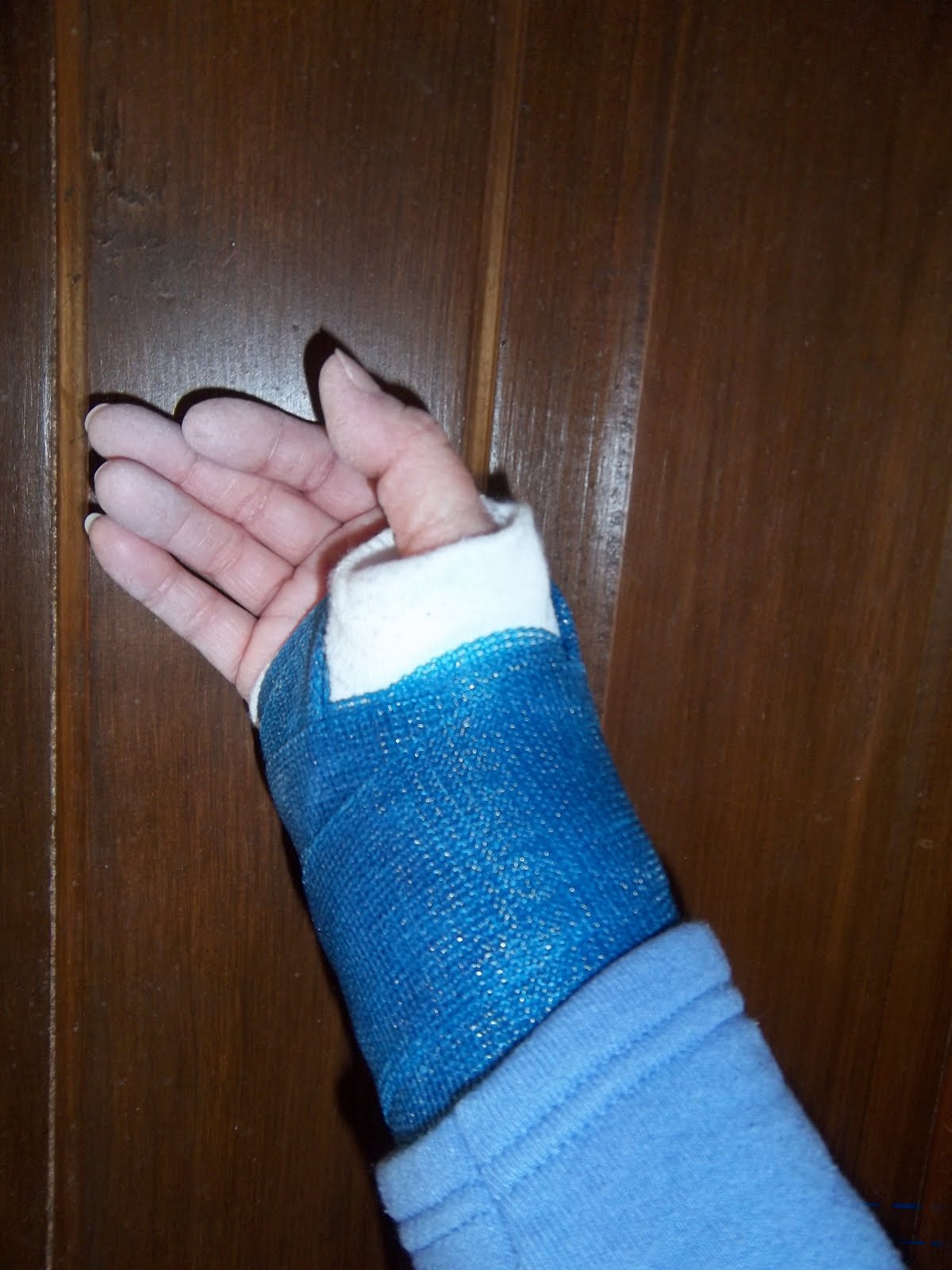
As you can see from the picture, my body has let me down again. This is the second broken bone in four years. Last time it was my right ankle. This time my right wrist. The cause in both cases - icy sidewalks.

I survived my childhood without breaking any bones, despite falling out of trees, off tire swings and rope trapezes. There were the not-unexpected cuts, bruises, sprains and splinters removed from the soles of bare feet (not even gravel roads could force us to wear shoes during the summer months).

When you're young, you think you're invulnerable. No matter how many times I fell out of the apple tree in the backyard (one time, to my mother's horror, onto the driveway), I was always back up in the branches. My tree-climbing days, however, soon ended once I started wearing glasses. I guess once I could actually see the distance to the ground (turns out I'm near-sighted), fear of heights finally kicked in.

I also caught most of the childhood ailments of my generation: chicken pox, measles, German measles (twice, I think), mumps, and lots of colds.

One guaranteed way to keep a sick or injured child put is to let her read. Sometimes the reading material will take her mind off the injury or illness, but sometimes misery loves company and finding a book where the character survives or just copes with the problem helps.

I remember measles was in Five Little Peppers and How They Grew by Margaret Sidney. Louisa May Alcott's Little Women had scarlet fever as a threat (before werewolves). And there were various sprains and such in Eight Cousins and Rose in Bloom. I don't recall why Heidi's friend was in a wheelchair, but it was something cured by mountain air.

A search through my local library's catalog brings up several books about chicken pox as well as books with characters in the midst of itching and trying not to scratch. The only one I find about measles is Five Little Peppers for fiction. I'm hoping that means more parents are opting for vaccines nowadays.

Fantasies will sometimes use plague as a major fear. But what about the childhood diseases considered "normal"? On the YA side of fantasy, there are Tamora Pierce's Magic Circle series and Healer Hall stories by both Mercedes Lackey and Anne McCaffrey, so any young reader could choose to focus on the healing side.

When I was young, I read my older sisters' Cherry Ames books, which were about a young nurse trying different areas (Camp Nurse, Army Nurse, etc.). Then I moved into my father's collection of science fiction and found James White's Hospital Station series, with a space hospital and all sorts of aliens as doctors and patients - and all sorts of diseases and injuries. Murray Leinster had a traveling space doctor, as did Alan E. Nourse (Star Surgeon) and later Jody Lynn Nye with her Taylor's Ark stories.

Serious injuries will still turn up in series. Harry Potter was laid up briefly with a broken (and then deboned arm). But often the action in current books take place over a week or month rather than the months needed for recovery. Short stories are good sources then, such as "The Smallest Dragonboy" by Anne McCaffrey, when a concussion and a broken leg almost costs a boy a chance at Impressing a dragon (fortunately the dragon hatchling staggers off in search of him).

The depiction of disabilities in science fiction and fantasy is always an interesting panel at science fiction conventions. The first book I remember reading with a disabled character was Anne McCaffrey's The Ship Who Sang, which then developed into a series about brainships. Lois McMasters Bujold's stories about Miles Vorkosigan is another good series. But there needs to be more. And not just about how the character escapes his chair as in the recent film Avatar. Why shouldn't a child in a wheelchair find a positive reflection in what she or he reads?

Children with glasses were proud of their eyewear with the release of Harry Potter. Those with dyslexia had a role model in Percy Jackson. What books have you found?